Unknown's avatar

Alaska wants the humpback whale off the Endangered Species list

Reblogged from the Washington Post.

“After teetering on the brink of extinction in the 1970’s, has the humpback whale recovered to the point they should be removed from the Endangered Species list?” ~ Andrew Wyatt

BY REID WILSON | March 1 at 6:00 am

File: Icy Bay, Alaska. Credit: Jon TigarFile:  Alaska. Credit: Jon Tigar

The state of Alaska wants the federal government to remove endangered species protections for humpback whales that migrate seasonally between Alaska and Hawaii, a step that would remove a hurdle for companies that want to explore the Arctic Coast for oil.

On Wednesday, Alaska’s Department of Fish and Game filed a petition with the National Marine Fisheries Service seeking to designate the specific subspecies of humpback that travels between the two states, and to take it off the endangered species list  because its population has rebounded from dangerously low levels just a few decades ago.

Read more at The Washington Post…

Unknown's avatar

Punch and Counter Punch: Does Lacey Act Have Authority Over Interstate Transport?

Reblogged from the US Herpetoculre Alliance.

“The reptile keepers trade association has filed suit against DOI Secretary Sally Jewell and US Fish and Wildlife Service, challenging among other things, the authority of the Lacey Act to limit interstate transport of Injurious Wildlife. The government has now entered a motion to dismiss. It will be intersting to see if the reptile keepers will be able to amend their pleading and survive this preliminary action.” ~ Andrew Wyatt

USARK v. Sally Jewell et al. Part One: Procedural Posture

Posted on February 25, 2014 by  Walsh

logo5The US Herpetoculture Alliance is receiving a lot of inquiries regarding the complaint filed by the United States Association of Reptile Keepers on December 18, 2013 against Sally Jewell, Secretary of the Interior, and US Fish and Wildlife Service challenging the Constrictor Rule to the Lacey Act.  We are not involved in the litigation and are not consultants on the litigation.  However, we are glad that USARK has taken affirmative action on behalf of herpetoculture to challenge what we agree is a completely aribitrary and capricious rulemaking.

This will be a series of blogs intended to help clarify the proceedings for non-lawyers.  These blogs are not intended as legal advice; we are simply reporting on the case progression and offering opinions as we see the issues.

Procedural Posture:  Where do we stand?

What is the Constrictor Rule?  On March 12, 2010, the US Fish & Wildlife Service (“FWS”) proposed a rule to add nine large constrictors to the list of injurious species under the Lacey Act.  On January 23, 2012, Defendants enacted a partial rule, adding four of the nine species (Burmese python, North African python, South African python, and yellow anaconda) to the injurious list.  The Constrictor Rule prohibits not only importation, but all interstate transport of the four species of large constrictors.  Defendants have yet to act on the remaining five constrictors, but it appears that a finalization of the Constrictor Rule to add additional species is imminent.

USARK files its lawsuit.  

What is USARK asking for?

USARK filed a complaint for injunctive relief and declaratory judgment.  This means that they are asking the Court to enter an order stating:

  • That in issuing the Constrictor Rule, Defendants violated the Administrative Procedure Act (“APA”) and the National Environmental Policy Act (“NEPA”);
  • That the Defandants lack legal authority to ban interstate transportation and commerce in the listed species because the ban on interstate transportation and commerce of injurious species is through administrative rule making and exceeds the expressed language of the Lacey Act;
  • That the Defendants enactment of the Constrictor Rule is ultra vires (meaning beyond their powers) and contrary to law;
  • Enjoining (barring) Defendants from applying the Constrictor Rule;
  • That FWS be required to prepare a lawful environmental impact statement and rational basis for any new rule proposed; and
  • Awarding USARK its costs and attorneys’ fees.

USARK is not seeking monetary damages in its action for injunctive relief and declaratory judgment.  This means that if USARK were to win, the provisions set forth above are what it has requested in its prayer for relief.  That is what USARK is asking for from the Court.

USARK’s arguments.

USARK argues that FWS was arbitrary and capricious in its enactment of the Constrictor Rule under NEPA and APA.

NEPA argument.  USARK alleged that Defendants failed to follow NEPA’s statutory requirements in that FWS did not prepare an environmental impact statement (“EIS”) and that its environmental analysis (“EA”) was inadequate.

APA argument.  The APA provides a right of review to persons adversely affected by an agency action within the meaning of a relevant statute.

  • USARK is claiming that in prohibiting interstate transport of the four species of constrictor snakes, FWS has exceeded its authority under the statutory provisions of the Lacey Act.
  • It also argues that Defendants failed to provide  reasoned bases for the enactment of the Constrictor Rule.

The Motion to Dismiss

Once a complaint is filed, the defendants have a proscribed amount of time in which to respond or otherwise plead.  In this case, Defendants filed a Motion to Dismiss.  A motion to dismiss is a predictable response.  It is the first volley from a defendant to see if they can get rid of a case due to pleading defects or other bars to a cause of action.

Defendants brought their Motion to Dismiss under Federal Rules of Civil Procedure 12(b)(1) and 12(b)(6).

FRCP 12(b)(1) states that a case should be dismissed when the court lacks subject matter jurisdiction.  Subject-matter jurisdiction is the authority of a court to hear cases of a particular type or cases relating to a specific subject matter.

FRCP 12(b)(6) allows a motion to dismiss for failure to state a claim upon which relief can be granted (pleading deficiencies).

Defendants first attack USARK’s standing to bring the complaint.  In very general terms, standing is the ability of a party to demonstrate to the court sufficient connection to and harm from the law or action challenged to support that party’s participation in the case.  There are some nuances that fall under the umbrella of standing.  Here, Defendants claim that USARK lacks prudential standing as well as constitutional standing.

Without getting into a lengthy legal discussion on standing, Defendants make a good argument about USARK’s lack of standing and Herp Alliance believes that the USARK complaint will be dismissed without prejudice on the basis of standing.  

This is not a fatal flaw.  It means that there are marks of haste in the USARK complaint and it was not drafted as carefully as it could have been.  If the Court dismisses the Complaint without prejudice, USARK will be given leave to amend its Complaint in order to cure its pleading defects.  The net result is that some time and money are wasted but USARK will likely be given a “do-over” for at least its actions under the APA, but only under NEPA if it can allege facts that establish that it has an environmental interest .

Defendants next argue that the statute of limitations has run on USARK’s challenge to the interstate transport issue because the regulation was established in 1965 and USARK is now time barred.  Herp Alliance believes that this argument is nonsensical and Defendants will not prevail on this argument.

Finally, Defendants argue that Count IV is duplicative of Counts I, II and III, which it likely is.

Conclusion

Herp Alliance believes that the Defendants’ Motion to Dismiss will be granted in part and denied in part.  As a result, we believe that USARK’s Complaint will be dismissed without prejudice and USARK will be granted leave to amend its complaint to cure the deficiencies that exist in the original pleading.

The net result is some lost time and money on attorneys’ fees without yet getting to the merits of any claim that can be asserted by USARK once its complaint is properly pled.  At this point, it is premature to conjecture as to Defendants’ responses to USARK’s substantive allegations because their Motion to Dismiss is technical and not a response to the factual allegations in USARK’s Complaint.

Unknown's avatar

WHAT WILL HAPPEN AFTER THE RHINOS ARE GONE?

Reblogged from Conservation Magazine.

“Are rhinos a keystone species on the African savannah? A new study from the Journal of Ecology forecasts dire consequences for ecosystems if the rhino disappears from the African landscape.” ~ Andrew Wyatt

February 19, 2014 / Conservation This Week

We don’t usually think of herbivores as keystone species. That’s a moniker we usually apply to apex predators, who can keep entire ecosystems in check and aren’t themselves subject to predation. But given their size, mature “megaherbivores” like white rhinos aren’t usually subject to predation either. If they can survive to adulthood, the main pressure on the size of their population, like for apex predators, is simply the availability of food. That allows them to exert disproportionate control over their environments, just as lions or wolves. According to new research published in the Journal of Ecology, Africa’s white rhinos (Ceratotherium simum) could be thought of as apex consumers.

The removal of apex predators from an ecosystem can be catastrophic. The oft-used examples are the Yellowstone wolves. When they were culled, the deer population exploded, which in turn meant that plant populations declined. The bears, who rely on many of the same berries on which the deer fed, also suffered from lack of food. When the wolves were reintroduced to Yellowstone, the entire community shifted back into balance.

Researchers are increasingly realizing that the removal of megaherbivores from their ecosystems can have similarly devastating impacts. In a 2009 paper in the journal Science, paleoecologist Jacquelyn Gill argued that the extinction of North American Pleistocene megaherbivores—mammoths, mastodons, horses, sloths, camels—drove similar large-scale ecosystem changes. The diversity and populations of plant communities were altered, which led to subsequent extinctions of other species.

Most research on the effects of plant eaters on the African savannah has focused on the other massive herbivore, elephants. So researchers Joris P. G. M. Cromsigt and Mariska te Beest turned to white rhinos. Rhinos aren’t just elephants with different ivory ornamentation, they also put pressure on different plant communities. Elephants are primarily browsers, eating from trees, while rhinos are grazers. Think of them like adorable lawn mowers with pointy spikes at the ends of their noses.

Wild rhinos may be driven to extinction within the next couple decades if current poaching rates continue. What will that mean for the African savannah?

Rhinos were driven out of South Africa’s Kruger National Park by 1896 due to hunting, and were reintroduced beginning in the 1960s. The reintroduction was a massive success: by 2010, there were some 10,000 to 11,000 individuals within the park. But they aren’t equally distributed. This presented Cromsigt and te Beest with a natural experiment. They compared parts of the park in which rhinos have grazed for several decades to other areas which have been only recently recolonized. To measure the ways in which rhinos exert pressure on the environment, they measured the quantity of short grass lawns within high- and low-density rhino areas and the surface area covered by those lawns.

Both measurements revealed more short grasses in high-density rhino areas compared with spaces that have only recently seen rhino activity. In the African grassland, short grass cover is a useful metric for botanical heterogeneity. The more short grass lawns, the more diverse the landscape.

At first this might seem counterintuitive; if rhinos are intensely grazing the land, shouldn’t plant communities suffer? The key is to think of them less as lawnmowers and more as…selective lawnmowers. “In many grassland and savannah systems,” Gill explained to me, “grazers increase biodiversity, by selectively eating certain kinds of plants over others.” In her own research she’s found that North American bison eat grasses and ignore forbs. (Sunflowers and milkweed are both types of prairie forbs.) By trimming the grasses, the bison allow the forbs, which normally can’t compete for light and water, a fighting chance to survive. “There is a lot of research that suggests that [grazers are] really important for maintaining diversity, as well as the coexistence of trees and grasses, by creating a shifting patch mosaic on the landscape,” she says.

Take away the rhinos from the landscape and, according to this research, the landscape will suffer. Cromsigt and te Beest say that their study highlights some of the indirect, yet important, effects of the rhinopoaching crisis. “Not only is rhino poaching threatening the species conservation status,” they write, “but also the potentially key role of this apex consumer for savanna ecosystem dynamics and functioning.” – Jason G. Goldman | 19 February 2014

Source: Cromsigt J.P.G.M., te Beest M. & Bellingham P. (2014). Restoration of a megaherbivore: landscape-level impacts of white rhinoceros in Kruger National Park, South Africa, Journal of Ecology. DOI: 

Photo: White rhino via Flickr/Mike Showbiz.

Unknown's avatar

Yes, Hotshot Harry Can Be A Hunter and a Conservationist, Too

“Prince Harry hates poaching… Loves hunting and conservation.” ~ Andrew Wyatt

Richard Conniff's avatarstrange behaviors

Prince Harry

Britain’s Prince Harry continues to take heavy flak for being simultaneously a hunter and a conservationist, with the appearance in today’s Daily Mail of the above photograph.  It’s 10 years old, and shows “Crackshot Harry, The Buffalo Killer” in Argentina, smiling over the carcass of a water buffalo, not exactly an endangered species.

Harry has been taking a public relations hit since going out earlier this month on a boar hunt in Spain immediately prior to making a public pledge to fight against the illegal trade in ivory, rhino horn, tiger parts and other endangered animals.

My Irish and American family background means I am no great fan of royalty, and I should probably welcome the endlessly clumsy, tone-deaf behavior by the British Royals.  It makes a better case for republicanism than any Fenian or Federalist ever did.  (And it’s so much more entertaining.)  But that said, a legal hunt…

View original post 100 more words

Unknown's avatar

A Landmark International Agreement to Halt Wildlife Trafficking Is Just the Beginning

“A rising middle class in China, Vietnam and other asian nations creates an enormous market for ivory, rhino horn and asian medicine. Until pragmatic ways to limit markets for illegal wildlife products can be found, I fear the ‘London Declaration’ may be just pomp and circumstance. As long as asian markets are open, poachers, organized crime and terrorists will continue to find ways to reap their profits much as the drug cartels take advantage of markets for drugs in the US, UK and Europe.” ~ Andrew Wyatt

Unknown's avatar

Lions and Rhinos and Gazelles… Oh My!

Can Private Conservation Contribute to Species Survival?

photo: Wikipedia- Nick Brandt

photo: Wikipedia- Nick Brandt

With conservation groups attending an illegal wildlife trafficking symposium in London this week, and the US announcing  its National Strategy on Wildlife Trafficking here at home, animal rights activists are using the opportunity to blur the lines between legal and illegal wildlife trade. Nevertheless, whether it is creating economic value for species preservation within local African communities, incenting captive breeding as a conservation safety net, or raising money for anti-poaching efforts, private commercial activity is an economic engine driving significant contributions toward the conservation of some of Africa’s most charismatic megafauna. Poachers for rhino horns, ivory and asian medicine markets are the true enemies, not legal hunting activities and captive breeding programs.

ranger brent stirton nat geo

Ranger patroling for poachers.
photo: Brent Stirton, National Geographic

Africa is proving to be a more and more difficult arena in which to affect real conservation.  No longer is the enemy simply corruption for personal enrichment. Recently, the Washington Post reported on the links between the astronomical amounts of money generated in the black market for rhino horn and elephant ivory, to funding for  al-Qaeda and other terrorist groups. With Vietnamese demand for rhino horn fetching $50,000- 100,000 per kilo, the level of violence perpetrated on black rhinos and the rangers responsible for protecting this “Critically Endangered” species, is almost unfathomable.

A similarly depraved dynamic drives the relentless slaughter of African elephants for their ivory. These huge ill-begotten profits are coveted by terrorists and sophisticated crime syndicates to fund operations. Numbers of elephants and rhinos poached have spiked exponentially over the last decade. Needless to say, the authorities in African nations are outgunned, ill-equipped and underfunded. In an effort to help fund efforts to protect rhinos the Dallas Safari Club raised $350,000 to fight poaching in Namibia with a conservation fundraising auction last month. Poaching, not controlled hunting, threatens the future of elephants and rhinos in Africa.

On another front, according to Duke University Professor Stuart Pimm, there are approximately 35,000 free ranging lions left on the African continent today. Although at a recent African lion workshop hosted by US Fish & Wildlife Service (FWS), three experts agreed that the lion is not currently in danger of extinction, US based animal rights organizations petitioned FWS to list lions as “Endangered” under the Endangered Species Act (ESA), citing hunting as a significant factor in lion decline. However, most conservation experts agree, habitat loss and human-lion conflict, not hunting, are the primary causes of the lions’ decline in Africa. To the contrary, hunting advocates have been the biggest barrier between the African lion and decimation by creating economic incentives for local communities to protect lions as a valuable and sustainable resource.

Addax Antelope

Addax Antelope

Meanwhile, back in the United States, Texas game ranchers are raising endangered African hoof stock in large numbers. A few years ago the Humane Society of the United States (HSUS) filed a lawsuit beginning a prolonged legal battle to block permitting by FWS of ranchers who have brought three endangered antelope species (the Scimitar-Horned Oryx, Dama Gazelle and Addax) back from the brink of extiction. The argument that these antelope are better off extinct than thriving on Texas game ranches was undercutting the economic value of the endangered gazelles and threatened to destroy all the good work these dedicated conservationists had done. Fortunately, legislation known as the “Three Amigos” bill, reinstated an exemption for captive bred specimens protected under the ESA, again allowing for  the propagation and trade of these three species, was passed on January 21, 2014– clearing the way for commercial interests to protect these magnificent animals from extinction.

The thrust of anti-hunting rhetoric has been to equate hunting to poaching and characterizing any economic activity involving animals as inherently immoral or unethical. These groups demonize hunting and hunters, and try to mold public opinion to be empathic to anti-hunting ideology by emphasizing the death of individual animals in dramatic fashion — hoping to trigger protective feelings from an animal loving public that relates to their own pets. They refuse to acknowledge the economic contributions made by commercial interests in wildlife and seek to characterize the economic value of animals to be exploitative and immoral.

“In a civilized and cultivated country, wild animals only continue to exist at all when conserved by the sportsman. The excellent people who protest against all hunting, and consider sportsmen as enemies of wildlife, are wholly ignorant of the fact that in reality the genuine sportsman is by all odds the most important factor in keeping wild creatures from total extermination.” ~ Teddy Roosevelt

The truth is, if they have no economic value, these animals are far more difficult to conserve. This fact is reinforced every day on the ground in Africa when a villager sees more value in protecting his livestock by poisoning a lion than he does in letting the lion live. Economic incentives are a vital component of 21st century wildlife conservation. Just as the illegal value of wildlife trafficking is driving many animals towards extinction, continuing to develop a legal economic value and trade for these same animals may be their only salvation. Private commercial conservation efforts are an intrinsic part any sincere effort at species preservation.

Unknown's avatar

National Strategy on Wildlife Trafficking

Reblogged from the International Conservation Caucus Foundation (ICCF).

“ICC Co-Chair Ed Royce has been providing leadership on illegal wildlife trafficking and poaching issues for some time. Here is the ICCF Conservation Update with some very informative links.” ~ Andrew Wyatt

ICC Co-Chair Ed Royce Provides Leadership on Poaching Crisis

shot2-1February 12, 2014

National Strategy on Wildlife Trafficking Fact Sheet Released by the White House

Today the United States announced a National Strategy for Combating Wildlife Trafficking.  The Strategy will strengthen U.S. leadership on addressing the serious and urgent conservation and global security threat posed by illegal trade in wildlife.

In addition to the strategy, we are also announcing a ban on commercial trade of elephant ivory, which will enhance our efforts to protect iconic species like elephants and rhinos by prohibiting the import, export, or resale within the United States of elephant ivory except in a very limited number of circumstances.

Taken together, these actions will help ensure that the United States is not contributing to poaching of elephants and illegal trade in elephant ivory.

THE STRATEGY

The National Strategy for Combating Wildlife Trafficking establishes guiding principles for U.S. efforts to stem illegal trade in wildlife.  It sets three strategic priorities: strengthening domestic and global enforcement; reducing demand for illegally traded wildlife at home and abroad; and strengthening partnerships with international partners, local communities, NGOs, private industry, and others to combat illegal wildlife poaching and trade.

THE IVORY BAN

Today we are also we are also announcing a ban on the commercial trade of elephant ivory, which will enhance our ability to protect elephants by prohibiting commercial imports, exports and domestic sale of ivory, with a very limited number of exceptions.  This ban is the best way to help ensure that U.S. markets do not contribute to the further decline of African elephants in the wild.

To begin implementing these new controls, federal Departments and Agencies will immediately undertake administrative actions to:

  • Prohibit Commercial Import of African Elephant Ivory: All commercial imports of African elephant ivory, including antiques, will be prohibited.
  • Prohibit Commercial Export of Elephant Ivory:  All commercial exports will be prohibited, except for bona fide antiques, certain noncommercial items, and in exceptional circumstances permitted under the Endangered Species Act.
  • Significantly Restrict Domestic Resale of Elephant Ivory:  We will finalize a proposed rule that will reaffirm and clarify that sales across state lines are prohibited, except for bona fide antiques, and will prohibit sales within a state unless the seller can demonstrate an item was lawfully imported prior to 1990 for African elephants and 1975 for Asian elephants, or under an exemption document.
  • Clarify the Definition of “Antique”:  To qualify as an antique, an item must be more than 100 years old and meet other requirements under the Endangered Species Act.  The onus will now fall on the importer, exporter, or seller to demonstrate that an item meets these criteria.
  • Restore Endangered Species Act Protection for African Elephants:  We will revoke a previous Fish and Wildlife Service special rule that had relaxed Endangered Species Act restrictions on African elephant ivory trade.
  • Support Limited Sport-hunting of African Elephants:  We will limit the number of African elephant sport-hunted trophies that an individual can import to two per hunter per year.

The United States will continue to lead global efforts to protect the world’s iconic animals and preserve our planet’s natural beauty for future generations.  Combating wildlife trafficking will require the shared understanding, commitment, and efforts of the world’s governments, intergovernmental organizations, NGOs, corporations, civil society, and individuals.

At this week’s London Conference on the Illegal Wildlife Trade, we hope other countries will join us in taking ambitious action to combat wildlife trafficking.  In the coming months, we will take further steps to implement the National Strategy, and will work with the Congress to strengthen existing laws and adopt new ones to enhance our ability to address this global challenge.

Read the National Strategy on Wildlife Trafficking

ICC Co-Chair Ed Royce demonstrated leadership on the issue of poaching and wildlife trafficking by urging the Presidential Task Force on Wildlife Trafficking for a bold strategy in December 2013.

Unknown's avatar

African Poaching Crisis: Elephants Slaughtered for Trinkets and Terrorism

Reblogged from the International Conservation Caucus Foundation (ICCF).

“Senator Rob Portman of Ohio, Co-Chair of the ICCF, weighs in on the African poaching crisis, the alarming links to terrorism, and how the the Conservation Reform Act might lend aid.” ~Andrew Wyatt

feb8_2014-1

Editor’s note: Rob Portman, a Republican, is a U.S. senator from Ohio.

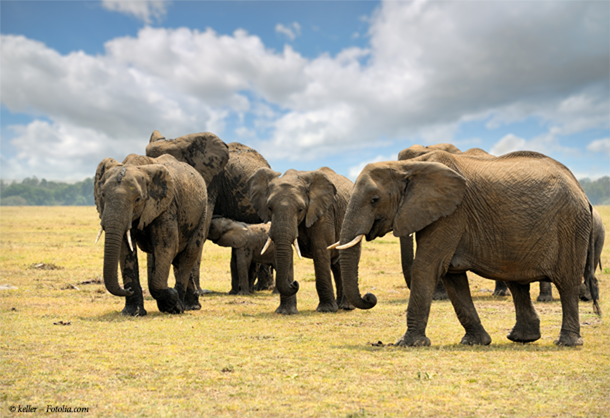
(CNN) — The African elephant, one of the world’s most majestic animals, is in danger. In the early 1900s, 5 million elephants roamed the African continent. Then the ivory trade drove them to the brink of extinction, with 90% of African elephants killed for the ivory in their tusks.

In 1989, the world reacted, imposing a ban on the international trade in ivory passed by the U.N. Convention on International Trade in Endangered Species. Elephant populations stabilized. But today, driven by growing demand for ivory ornaments and carvings in Asia, particularly in China, elephant poaching has returned with a vengeance.

The largest slaughter in one year since the 1989 ban was passed happened in 2012, with up to 35,000 elephants killed. This adds up to nearly 100 a day. Tens of thousands are killed every year. Without action, the day may come when this magnificent creature is known only in history books.

Estimates say if elephants continue to be slaughtered at today’s rates, the creatures could be extinct in a decade.Not only do elephants die. The wildlife rangers who try to protect them from poachers are being killed.

The illicit trade in ivory — “white gold” — is a billion dollar industry, and because it is illegal, it tends to attract some very bad actors. It is blood ivory: Al-Shabaab, a wing of al Qaeda based in Africa that is responsible for continued instability in Somalia, is known to finance its operations through the poaching of elephants. Al-Shabaab raises an estimated $600,000 a month through the ivory trade. The Lord’s Resistance Army, another terrorist group infamous for forcing children to fight in its ranks, also engages in poaching and trafficking of elephant ivory.

 “Al-Shabaab raises an estimated $600,000 a month through the ivory trade.” ~Rob Portman

Stopping the ivory trade has become not only a matter of conservation but one of national security and international stability.

Last year, the United Nations issued a report warning that elephant poaching is the worst it has been in a decade, while ivory seizures are at their highest levels since 1989. Last summer, President Barack Obama issued an executive order recognizing that the poaching of protected species and the illicit trade in ivory has become an international crisis that the United States must take a leading role in combating.

Saving elephants and other threatened species is a cause that cuts across partisan lines and international boundaries. We all have a part to play.

It starts in our personal lives.

The ivory trade prospers because there is a demand for luxury goods fashioned from it. As consumers, we should never buy products made with ivory and should encourage others to be mindful that their purchases are not illegally sourced through trafficking. And we should continue to shine a spotlight on the problem of illegal poaching and the threat it poses to African elephants and other species.

There are actions our government can take, as well. As co-chairman of the U.S. Senate International Conservation Caucus, I have worked with my colleagues on both sides of the aisle to educate members of Congress on these ongoing problems and introduce legislation that authorizes proven conservation programs and directs resources to the international effort to dismantle the machinery of illegal poaching.

The Conservation Reform Act is part of this effort. If passed, it would streamline and increase the effectiveness of our existing international conservation efforts. I am also working to reauthorize the Saving Vanishing Species Stamp, which raises funds for the protection of threatened animals and their habitat at no cost to the U.S. taxpayer.

Over the years, we have watched as the actions of a few shortsighted, malicious and greedy people have nearly destroyed whole species. If we act now, we can make sure that the African elephant doesn’t become another sad entry on a long list of animals we can never bring back.