
“The immortal ‘Lonesome George’ will be remembered as the last of his sub-species of Galapagos tortoise.” ~Andrew Wyatt

“The immortal ‘Lonesome George’ will be remembered as the last of his sub-species of Galapagos tortoise.” ~Andrew Wyatt
“The Safari Club International “walks the walk” by making direct investment in “Conservation through Captive Breeding.” ~Andrew Wyatt
“Fossil Rim demonstrating once again the invaluable contributions to ‘conservation through captive breeding’ made by the private sector in Texas!” ~ Andrew Wyatt
During the 1980s and 1990s the country of Zimbabwe had a thriving population of black rhinos and they were managed well by the government and by private ranchers. Unfortunately, poaching came to their country and the conservation of many species was threatened—including black rhinos.


Captive rhino managers in the United States and Australia combined resources and approached the government of Zimbabwe with the idea of bringing ten rhinos to the United States and ten rhinos to Australia as an assurance population against the extinction of the species in Zimbabwe. Fossil Rim was an instrumental player in the formation of the International Black Rhino Foundation (now called the International Rhino Foundation—and focusing on all rhino species), which had the mission of capturing, transporting and managing southern black rhinos ex situ (outside of their normal range, usually meaning captive management). There were several months of negotiations—field experts thought they had about 2500…
View original post 943 more words
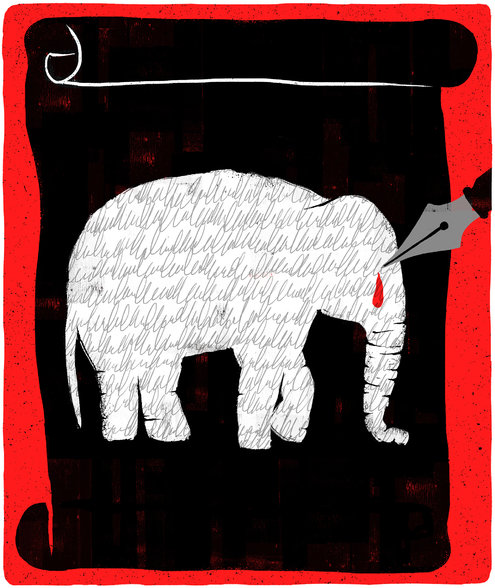
As written for National Geographic: A Voice For Elephants

Photograph by Bruce Dale/National Geographic Creative
By Andrew Wyatt and Doug Bandow
Nothing embodies the power and majesty of wild Africa like the iconic elephant. Tragically, across the continent you can see the devastating impact poaching has had on this keystone species. “Blood ivory” poachers ply their trade from the killing fields of the African savanna to the major markets in Asia. Decades of poor policy have resulted in dead elephants littering the African landscape.
Unfortunately, the Obama administration is making policy even worse. It is calling for more “ivory crush,” the destruction of existing ivory stores, and a ban on the legal trade of ivory within the United States. These proposals reflect a desperate misunderstanding of the illegal market and will only accelerate the slaughter of African elephants.
For instance, in early April Belgium joined the U.S., China, and host of other nations in the growing Ivory crush movement—supposedly to “send a warning” to ivory poachers. Alas, decreasing the world’s stockpile of ivory actually drives prices for blood ivory upward, thereby increasing profits for sophisticated poaching syndicates.
In early February, the Obama administration introduced the National Strategy for Combating Wildlife Trafficking. Two weeks later, the U.S. Fish & Wildlife Service (FWS) announced it would effectively ban all domestic ivory sales, even of antique objects. This step would punish the law-abiding while encouraging them to look for illegal outlets for their collections and inventories.
Unfortunately, the administration is playing the politics of deception, or at least deliberate misinformation. There is no doubt that poaching poses a threat to thousands of African elephants. But exaggerating claims for political advantage interferes with developing an effective conservation strategy.
FWS Director Dan Ashe and others have been circulating misleading information on elephant deaths, poaching, and the illegal ivory trade to advance an ideological agenda rather than to protect elephants. Among the more serious errors: “More than 35,000 elephants were killed in 2013 for the illegal ivory trade.” According to the Convention on International Trade in Endangered Species (CITES) program of Monitoring the Illegal Killing of Elephants (MIKE), 25,000 elephants were illegally killed in Africa in 2011 and 22,000 were killed in 2012. While still unacceptably high, it is far less than the 35,000 (with some claims hitting 50,000) that has become the rallying cry for those campaigning to ban even old, legal ivory sales.
Moreover, not all of these elephants were killed by poachers. Many were killed by farmers and villagers, for whom elephants are dangerous pests. The World Wildlife Fund estimates elephants killed for their tusks at approximately 20,000 per year. The figures for 2013 have not yet been released, but probably are of the same magnitude as before. In fact, John Scanlon, CITES Secretary-General, recently stated that he saw “encouraging signs” that poaching may be stabilizing.
“The United States is the second-largest market for ivory in the world.” This statement, although true, is misleading. According to a study of domestic ivory trade by two wildlife specialists entitled The USA’s Ivory Markets—How Much a Threat to Elephants?: “The USA has the second-largest ivory market in the world, after China-Hong Kong. The illegal proportion of it, however, is much smaller than any country in Asia and most countries in Africa. The USA ivory market poses a minimal threat to elephants.” FWS spokeswoman Sandra Cleva said: “The vast majority of U.S. seizures involve small non-commercial quantities, a fact that refutes the claim that large-scale illegal ivory trade exists in the United States.” According to the monitoring network TRAFFIC, Thailand is actually the second-largest market for illegal ivory in the world.
The fact that supposedly responsible government officials knowingly mislead the public demonstrates how the ivory debate has become politicized, with an emphasis on symbolism rather than solutions. Fighting poaching and stemming the flow of “blood ivory” is difficult. It is far easier to feign empathy by punishing the innocent owners of ivory objects, even if decades or centuries old.
The Ivory crush is merely foolish, inflating illegal ivory prices and denying revenues to the developing states that contain most elephants. Worse is the plan to render legally valueless virtually every piece of ivory in America, even though accumulated over many years in compliance with the law.
The administration already has barred the import of ivory, even if centuries old with peerless provenance, punishing American collectors and dealers. Craftsmen repairing or working with old and legal raw ivory could lose their livelihoods. Owners of vintage musical instruments and guns are prohibited from leaving and returning to the U.S. with them.
Any item containing a tiny fleck of ivory in it could trigger federal legal action. The administration said it will not target “knick-knacks,” but people with hundreds, thousands, or millions of dollars worth of ivories will find no legal buyers, since the administration plans to require documentation that does not exist. And the easiest way for FWS employees to boost their enforcement statistics would be to target confused collectors and dealers rather than accomplished criminals who operate in the shadows.
Obvious alternatives exist. Any plan should target poachers and their U.S. contacts. FWS should enlist legitimate collectors and dealers in helping to uncover the illegal trade, rather than treat the law-abiding as enemies. FWS could issue a “passport” for musicians and gun owners to carry their possessions back and forth. If the agency—with the consent of Congress, rather than in a secretive rule-making process—is determined to more clearly delineate old legal ivory, it could phase in a registration system for legal ivory objects.
Those who own and work in ivory are as appalled as everyone else about the slaughter of elephants for their tusks. But the policy adopted should actually achieve its end, rather than encourage the trade in “blood ivory.” Moreover, the government should not punish law abiding, tax paying citizens who followed long-standing law in accumulating ivory. Federal policy should be both effective and fair.
Andrew Wyatt is a government affairs consultant with Vitello Consulting who works in the wildlife sector. Doug Bandow is a Senior Fellow at the Cato Institute.
As written for National Geographic: A Voice For Elephants
Reblogged from the Liberty Blog
The powers of Congress are limited by the US Constitution, not the Endangered Species Act. ~Andrew Wyatt
April 29, 2014 | Jonathan Wood
 An animal rights group has filed a lawsuit arguing that the Endangered Species Act — which is itself constitutionally suspect — limits Congress’ powers, i.e. Congress cannot legislate on endangered species issues unless that legislation would be consistent with the ESA. This absurd proposition has already been rejected by that bastion of anti-environmentalism: the Ninth Circuit, which recently characterized the protection of endangered species as the “highest priority” under federal law.
The subject of the most recent controversy is a permit exemption for exotic hunting ranches, which finance populations of species that are endangered or extinct in the wild through regulated hunting. This fantastically successful model for species conservation has been consistently attacked by animal rights groups. A few years ago, 60 Minutes produced a piece on this success and interviewed those on both sides of the political and legal fight. Lest you have any doubt that the opposition isn’t about species conservation, the leader of the animal rights group is asked directly whether she would rather see these species go extinct than be saved in this way.
And she said yes!
“Jamaica to cave in to Chinese on deal that would seal the fate of one of the country’s most pristine areas, and home to the endangered Jamaican Iguana.” ~Andrew Wyatt

Tourism has long been the leading economic sector in Jamaica, bringing in half of all foreign revenue and supporting a quarter of all jobs. Yet government officials now risk jeopardizing that lucrative business, and Jamaica’s reputation in the international community, with a secretive deal to let a Chinese company build a mega-freighter seaport in the nation’s largest natural protected area.
The planned port would occupy the Goat Islands, in the heart of the Portland Bight Protected Area, which only last year the same government officials were petitioning UNESCO to designate a Global Biosphere Reserve. Instead, the lure of a $1.5 billion investment and a rumored 10,000 jobs has resulted in the deal with China Harbour Engineering Company, part of a conglomerate blacklisted by the World Bank under its Fraud and Corruption Sanctioning Policy.
Many details of the proposed project remain unknown, and the government has rebuffed repeated requests for information…
View original post 770 more words
The Safari Club International steps up to protect conservation through captive breeding of the ‘Three Amigos’ antelope! ~Andrew Wyatt
 Safari Club International has been granted intervenor status in federal district court to defend
Section 127 of the Consolidated Appropriations Act of 2014
. The new provision, signed into law on January 18, 2014, exempts the taking of members of U.S. herds of the scimitar-horned oryx, dama gazelle and addax from most permit requirements associated with their endangered species status. Section 127 directed the U.S. Fish and Wildlife Service (FWS) to reissue a 2005 rule that excuses private ranchers from obtaining permits to cull and to sell culling opportunities for members of their three antelope herds. Even before the FWS reissued the 2005 rule, Friends of Animals filed a
lawsuit
to challenge the constitutionality of Section 127. Their lawsuit claims that, by passing the legislation, Congress illegally interfered with the authority of the judiciary which constitutes a violation of the constitutional separation of powers doctrine. This is not the first…
Safari Club International has been granted intervenor status in federal district court to defend
Section 127 of the Consolidated Appropriations Act of 2014
. The new provision, signed into law on January 18, 2014, exempts the taking of members of U.S. herds of the scimitar-horned oryx, dama gazelle and addax from most permit requirements associated with their endangered species status. Section 127 directed the U.S. Fish and Wildlife Service (FWS) to reissue a 2005 rule that excuses private ranchers from obtaining permits to cull and to sell culling opportunities for members of their three antelope herds. Even before the FWS reissued the 2005 rule, Friends of Animals filed a
lawsuit
to challenge the constitutionality of Section 127. Their lawsuit claims that, by passing the legislation, Congress illegally interfered with the authority of the judiciary which constitutes a violation of the constitutional separation of powers doctrine. This is not the first…
View original post 61 more words
Reblogged from The New York Times.
The New York Times | The Opinion Pages |OP-ED CONTRIBUTORS
By GODFREY HARRIS and DANIEL STILESMARCH | 26, 2014
 THE year was 1862. Abraham Lincoln was in the White House. “Taps” was first sounded as a lights-out bugle call. And Steinway & Sons was building its first upright pianos in New York.
The space-saving design would help change the cultural face of America. After the Civil War, many middle-class families installed them in their parlors. The ability to play the piano was thought to be nearly as important to the marriage potential of single ladies as their skill in cooking and sewing, signaling a young woman’s gentility and culture.
The keys on those pianos were all fashioned from the ivory of African elephants. And that is why one of these uprights, the oldest one known to survive, in fact, is stuck in Japan.
The director of the United States Fish and Wildlife Service recently issued an order prohibiting the commercial importation of all African elephant ivory into the United States. (Commercial imports had been allowed in some instances, including for certain antiques.)
The Obama administration is also planning to implement additional rules that will prohibit, with narrow exceptions, both the export of African elephant ivory and its unfettered trade within the United States.
The Fish and Wildlife Service has said that these new rules will help stop the slaughter of elephants. But we believe that unless demand for ivory in Asia is reduced — through aggressive education programs there, tougher enforcement against the illegal ivory trade and the creation of a legal raw ivory market — these new American regulations will merely cause the price to balloon and the black market to flourish, pushing up the profit potential of continued poaching.
In short, these new rules proposed by the Fish and Wildlife Service may well end up doing more harm than good to the African elephant.
Read more at The New York Times...
Reblogged from Conservation Magazine.
According to a NEW study, an over-increase in elephant density does not equate to increased eco-tourism, and could actually lead to a decrease in biodiversity. ~Andrew Wyatt

Image © Alexandra Lande | Shutterstock
March 20, 2014 | Conservation This Week
If you have more elephants, they will come. That’s been the philosophy behind attracting tourists to wildlife reserves in South Africa. But this assumption is flawed, according to a new study in Ecological Applications. Increasing elephant density doesn’t translate to more ecotourism, and doing so could end up hurting the biodiversity that these parks are meant to protect.
Reserve managers depend on tourists for much-needed revenue. To keep visitors happy, managers often bring in more impressive animals such as elephants. But these charismatic creatures can damage ecosystems. For example, large numbers of elephants can knock down trees and reduce the number of plant species, which in turn can lower the diversity of animals.
The researchers studied five private reserves and an ecotourism operator in South Africa, where visitors can go on guided tours to spot animals. For each site, the team members found out how frequently tourists saw elephants in 2010. They also analyzed data on elephant populations and tourism in Addo Elephant National Park, South Africa from 1954 to 2011.

The scimitar-horned oryx was declared extinct in the wild in 2002
photo: Exotic Wildlife Association
Recently, in a legal ploy designed to undermine the “Three Amigos” provision of the Appropriations Act of 2014, the Friends of Animals (FoA) filed a federal lawsuit to try and stop the conservation of three endangered antelope species.
In a legal and legislative skirmish beginning in 2005, conservationists and animal rights activists have battled over the fate of three endangered antelope. It began when US Fish & Wildlife Service (FWS) added the scimitar-horned oryx, dama gazelle and addax (a|k|a the Three Amigos) to the Endangered Species list– but allowed an exemption for legal trade and hunting of captive bred specimens here in the United States. FoA and other animal rights activists filed a federal lawsuit hoping to overturn the exemption and block these captive conservation efforts. Subsequently, in 2009 they got their wish, the U.S. District Court for the District of Columbia struck down the FWS exemption, putting the Three Amigos in jeopardy of extinction once again. Then, in January of this year, the Appropriations Act of 2014 was passed and signed into law by President Obama with a “Three Amigos” exemption that once again cleared the way to conserve the endangered antelope through captive breeding.
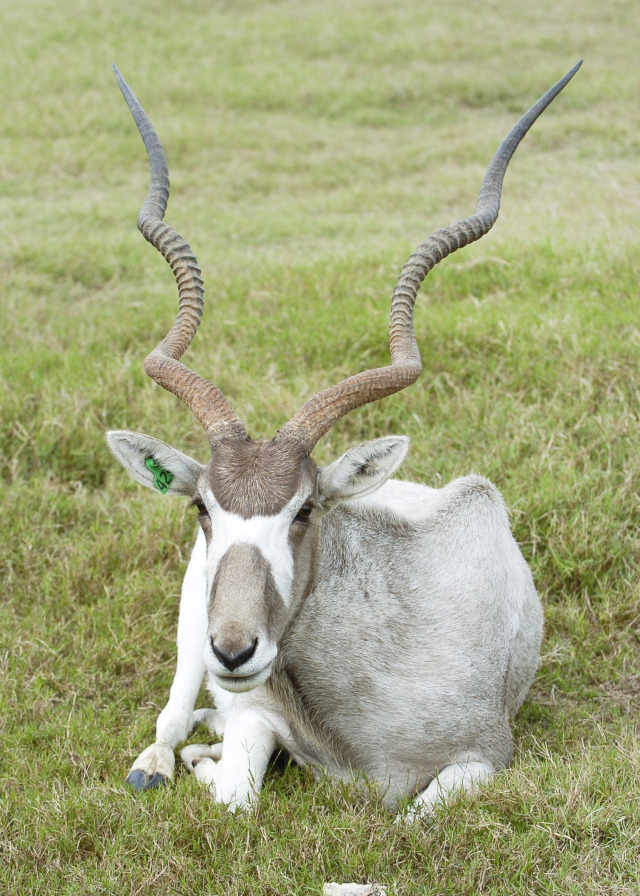
Addax
photo: Fossil Rim
This is about more than legal and political wrangling. It is about endangered species conservation on a grand scale. It is about hunters and ranchers turning species away from the brink of extinction. Today, thanks to the dedication and sound husbandry of ranchers, there are thousands of scimitar-horned oryx and addax, and a growing population of dama gazelle, thriving on tens of thousands of acres in Texas. This private model of conservation has been a resounding success and has not cost the taxpayer a dime. It is an unprecedented conservation safety net that has been villanized by its critics for what appears to be purely ideological reasons.
The Humane Society of the United States (HSUS) and other members of the animal rights industry stand for the proposition that hunting is morally wrong in all circumstances. HSUS has characterized hunting on a game ranch as a “canned hunt,” falsely conjuring images of blood thirsty men slaughtering trapped animals from the backs of pick-up trucks. Michael Markarian, HSUS Chief Program and Policy Officer, said, “hunters can bag endangered animals in drive-thru killing operations.” But when 60 Minutes did a segment on hunting on Texas game ranches, they did not find that Markarians’ comments rang true. In the spirit of “fair chase,” the hunter that was followed by the 60 Minutes crew lost an opportunity when the antelope eluded him in heavy cover.
Dama gazelle
photo: Exotic Wildlife Association“Fair chase” is the opportunity to avoid being found, and once found, the ability to detect and escape the hunter. ~Charly Seale, Executive Director, Exotic Wildlife Association
Charly Seale of the Exotic Wildlife Association (EWA), says that only a small percentage of surplus antelope on ranches are made available to hunt. Some are sold to other ranchers. Others are sent back to their countries of origin in an attempt to reintroduce them to their natural habitats.
Those that are hunted are carefully selected. They live in wide open areas, often on thousands of acres, much as they do in their native range. A hunter must track and locate the proper animal just to have an opportunity. The EWA has a Code of Ethics that upholds the concept of “fair chase.” There is no guarantee of success, and the antelope can and often does, elude a potential hunter.
The point is that because of hunting, these antelope have a tangible economic value that makes it possible to populate large herds right here in the US; a private model of conservation that costs the taxpayer nothing and demonstrates the commitment to preservation of species by hunters and ranchers. These programs have demonstrated their success already by preventing extinction, by making animals extinct in the wild, prolific in captivity. Make no mistake, hunting is conservation.

“A lifetime struggle against the depravity of recreational hunting.” ~Priscilla Feral, President, Friends of Animals
In the new book The Invisible Ark: In Defense of Captivity, Dave and Tracy Barker write of the inherent value of captive breeding as a conservation safety net. They espouse the principle that 21st century conservation depends upon creating economic incentives for local communities to preserve species. They denounce what they call the “Mantra of the Damned,” now adopted by some animal rights activists, which stands for the ideology, “better extinct than only in captivity.” Priscilla Feral, president of FoA embodied that dark sentiment when Lara Logan of 60 Minutes asked her, “…you would rather they [scimitar-horned oryx] not exist at all?” Feral responded, “not on a ranch in Texas.” To her, extinction of an entire species is preferable to thriving on hunting ranches in Texas.
The main driver for conservation here is a passion for these antelope. For the ethical hunter and conservationist, it would be a travesty of justice for these animals to disappear when there is the power and the means to save them. To forsake these magnificent creatures, and deprive our children of the opportunity to see them, just because some don’t philosophically approve of the only means of conservation that has proven to work, is unfathomable.
“For more than a century, [hunters] have been the backbone of conservation in this country…” ~Sally Jewell, Secretary of the U.S. Department of the Interior – March 4, 2014
In a private economically driven model of conservation, hunters and Texas game ranchers have brought these magnificent antelope back from the edge of extinction. The Three Amigos have been given economic value that has paved the way for conservation. The EWA is working to return a dozen scimitar-horned oryx to their native range of Senegal in 2015. Another ranch and wildlife park, Fossil Rim, spends $250,000 a year returning scimitar-horned oryx and other endangered species to their native range. Thousands of tourists, school groups, scouts and church groups visit Fossil Rim every year. None of this will be possible if FoA succeeds in overturning the Three Amigos provision of the Appropriations Act of 2014.


 The Last Word on Wildlife